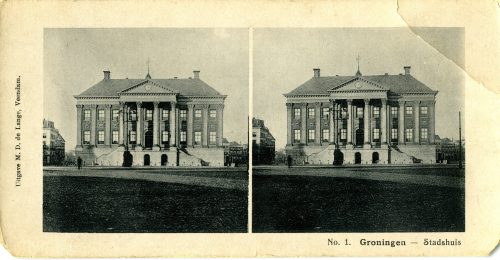
The Groningen City Hall (1810) may be interpreted as a changeless locus in a changing city; some kind of spinal structure which functions as a safeguard of the city’s representation, a backdrop by which the city’s symbolical form is retained and from which new signatures are made and performed against. Raised on a high stone pedestal, this building in some strange capacity not just encloses its own interior, but also protects the city’s center point; a rationale which sustains order. However, deepening into its biography, the stability of this predetermined image proved to be more vulnerable that I thought It would have. The number of alterations made to the design, before and after its completion, show how a building of such a representative nature is entirely subjected to change. On one hand we have the ideal Platonic geometry radiating from within, and in line with Classicist tradition. On the other hand, we have the context-bound conditions that shape the building from without. The buildingʼs biography can be told by the clash that occurs between those two binary forces, and therefore the struggle inherent to a type having to adapt to circumstance. Reading the buildingʼs biography, the changes that have been made are all responses to the cityʼs center-point being shifted over time and the town hallʼs face is thus simply following this trajectory. As a compass, the town hallʼs architectural features spiral around its own spine, as it constantly reconfigures to a new area of prominence. This path starts off in medieval times when a cluster of 14th and 15th century governmental buildings are oriented towards the west. With the design for a new town hall this orientation then shifts to the north, having its frontal staircase oriented in this direction, while the council chamber is directed toward the less prominent eastern square. Eventually, the plan makes another quarter turn as the front façade would correspond better with the proportions of the ʻGrote Marktʼ. Since the council chamber now happened to be located on the less prominent south façade, it was again displaced to the northern section. Also, exterior, and interior staircases changed in terms of position and shape several times, while the roof, pilasters and overall decorative layout has consequently taken on different forms. After its realization, the brick enclosure itself has also been subjected to change: from a central courtyard exposed to the elements, to the western section being removed to form a U-shaped plan, the courtyard was again closed off before a completely new entrance-wing was realized in the 60s. In other words, its circle was completed; it was again oriented towards the west, like its medieval predecessor. While the expansion was eventually demolished and the east façade would regain its authority, the council chamber would continue its private adventure within the enclosing walls: from being situated bellow the naturally illuminated courtyard on the ground floor, it was hoisted to the top floor, allowing a new civic hall to be formed underneath.
So, looking at the number of alterations made to Huslyʼs original design, and the eventual return to some of his design principles, it shows how the buildingʼs ideal form never fully exist. We could also say that in the process of translating the ideal into the physical, it has to sacrifice its own desired outcome ‒ or as Italo Calvino might have said: its desire is already a memory. Within the process of extracting the thing from the idea, the thing itself becomes a memory of the original idea, instead of the other way around – a process of signification. Now, the real appears as a ruin of seemingly unfulfilled idealities, which brings us to the question, how can we create urban and architectural kinship when such an environment, naturally, disproves of being contained by a singular, absolute form? I believe this is possible by making a clear distinguishment between languages of cohesion that are inherent to architectureʼs own physical body, and the ones projected onto them by an authority. Dichotomies in the urban context, the clear separation of objects in terms of ownership, have posed the idea that the ʻinteriorityʼ of a thing does not belong to the spectator, only its exteriority: a public stair is not in my possession, it is of the State. These hard segmentations in the architectural discourse, of private and public, create an alienating effect. The categorization of objects in such terms, which make them impermeable, can at one hand be rooted in the original generative idea of a thing ‒ a crown, a fence, or a marble tile, and the way in which a thing becomes part of a larger authoritarian projection: sovereignty/hierarchy, territoriality, wealth. Though, once made, an object can relinquish its share in this process and dismantle from its political framework and behavioral agenda, to return to architectureʼs own immanence, as was also argued by Jill Stoner in Toward a Minor Architecture. In linguistic terms, the object – whether it is a section of a building or an architectural feature ‒ may nowserve as a unit of first articulation, namely a ʼsyllabicʼ instance, and is from here able to recreate a second articulation, the ʻwordʼ, without its previous symbolic attachment. With the syllable being the starting point of a new narrative, it may function as gateway into a process of an architectural pattern language existing beyond the buildingʼs own parameters. The recognition and formation of such a spatial code, as one that blurs the inside/outside dichotomy, might be the beginning of a sense of kinship within the urban playground of haphazard architectures.

Unpublished Work © 2023 Joseph Gardella
 Joseph G. Gardella: Portfolio