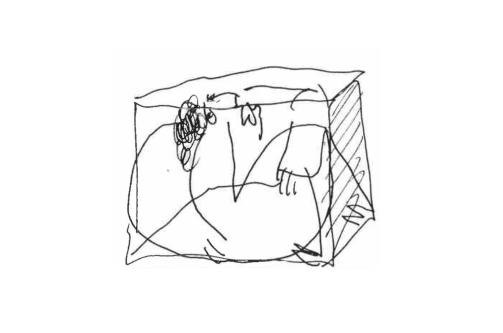
The story that is about to unfold is about a room. We shall enter this room and within it we will meet its construction: the earth, the sky, the sea and the horizon. This construction belongs to the world, the material world. It is a familiar world of familiar things. It is our everyday life and immediate environment. It shall be there when we enter the room and it shall be there when we leave it. This story allows us to dwell in the room. It is the room of Sverre Fehn.
Featured image: ‘the imaginary as the room,’ Sverre Fehn, in: Per Olaf Field, Sverre Fehn: Pattern of Thoughts, 2009.
The following fragments are part of a Bachelor thesis written about the Norwegian Modernist architect Sverre Fehn (1924-2009). Each short fragment portrays a particular ‘poetic origin’ rooted in his work. The aim of the thesis is to expose Fehn’s oeuvre and show what he can teach us about architecture that is once again formed by a poetic understanding of the world we live in.
Nordic Space: Outside & Inside
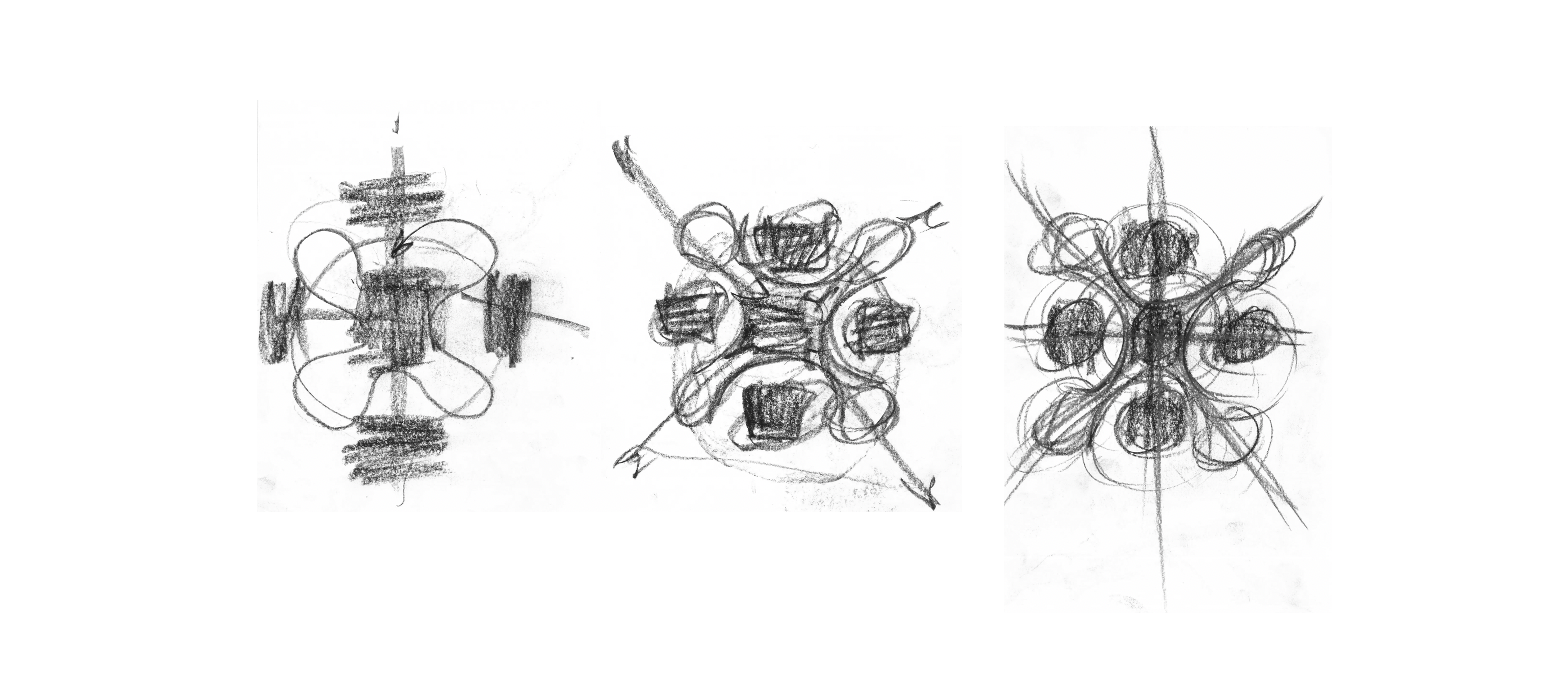
The Norrköping House is a structure that belongs to time. Life revolves within the house according to the circadian circle, as its rhythm breathes and activates space. The blind walls form a cave like space, which in turn contrast the house its corners: each one of four is activated during a certain period of the day, allowing light to enter the house diagonally, and therefore suggesting a movement which follows a parabolic flow between light and dark. The Norwegian author and architect Per Olaf Fjeld argued that “it is the glass corners that direct the light, and from here one can withdraw into a situation that is almost dark if desirable. One enters a cave like situation,” something also emphasised by Ulf Grønvold, who puts this secluding character in a Nordic context: “The Nordic people need to protect themselves from nature. Like the bear it must have its den.” In other words, the brick alcoves become the realm of the private, with the fireplace being nestled in the depth of this fabric. When the day transforms into the night, activity is naturally guided away from the corners and into those places. Through one’s continuous interaction with the forces of nature, the Norrköping House sits at a strange interface of a Nordic longing for a refuge in cave-like spaces, away from outside conditions, while simultaneously breaking this stigma by transforming that particular architectural feature of the shed, in which one finds this distance, the corners, which open up to the world. As for many other instances, Fehn ironically confronts regional and modern interpretations of space, and from this conflict sets up his narrative.

Nordic Space: Above & Below
In 1962, Fehn explained that the double-layered roof structure of the Nordic Pavilion was designed with the intention to create “an atmosphere of the Nordic shadowless world”. His capability of making a distinction between different types of light was an important lesson learnt during his trip to Morocco of 1951. Fehn claimed: “In Africa, shadows are strong and provide the landscape with sharp contours. In the north, nothing in discerned so clearly, the sun does not make such shadows, the world is hazier and more obscure, almost without shadows.” Christian Norberg-Schulz also emphasized on this distinction by explaining how it affects the way space and object are perceived. As the southern sun rises to the zenith, all things are encompassed directly; resulting in the effect that all objects “appear as bodies” and “become discrete”. Contrastingly, Nordic light is low in intensity and catches things obliquely. Space and object are not made explicit and do not express clarity of form, nor a state of completion. Norberg-Schulz continued by arguing that space is therefore perceived as being in a continuous “process of becoming”, as light does not provide fixed spatial boundaries, leading to an atmospheric and shadowless whole. It is this atmospheric state that generates the mystical quality with which the the Nordic countries are identified. Its Romantic heritage is in the same way characterised by an “unceasing search for discovery” as a result of the mystique quality produced by its light hues. In the case of the Nordic Pavilion, the roof structure allows the Venetian light to undergo a metamorphosis, resulting in a soft and shadowless light that takes away the rigidity of the structure and the hardness of the concrete, also diminishing the border between interior and exterior space.
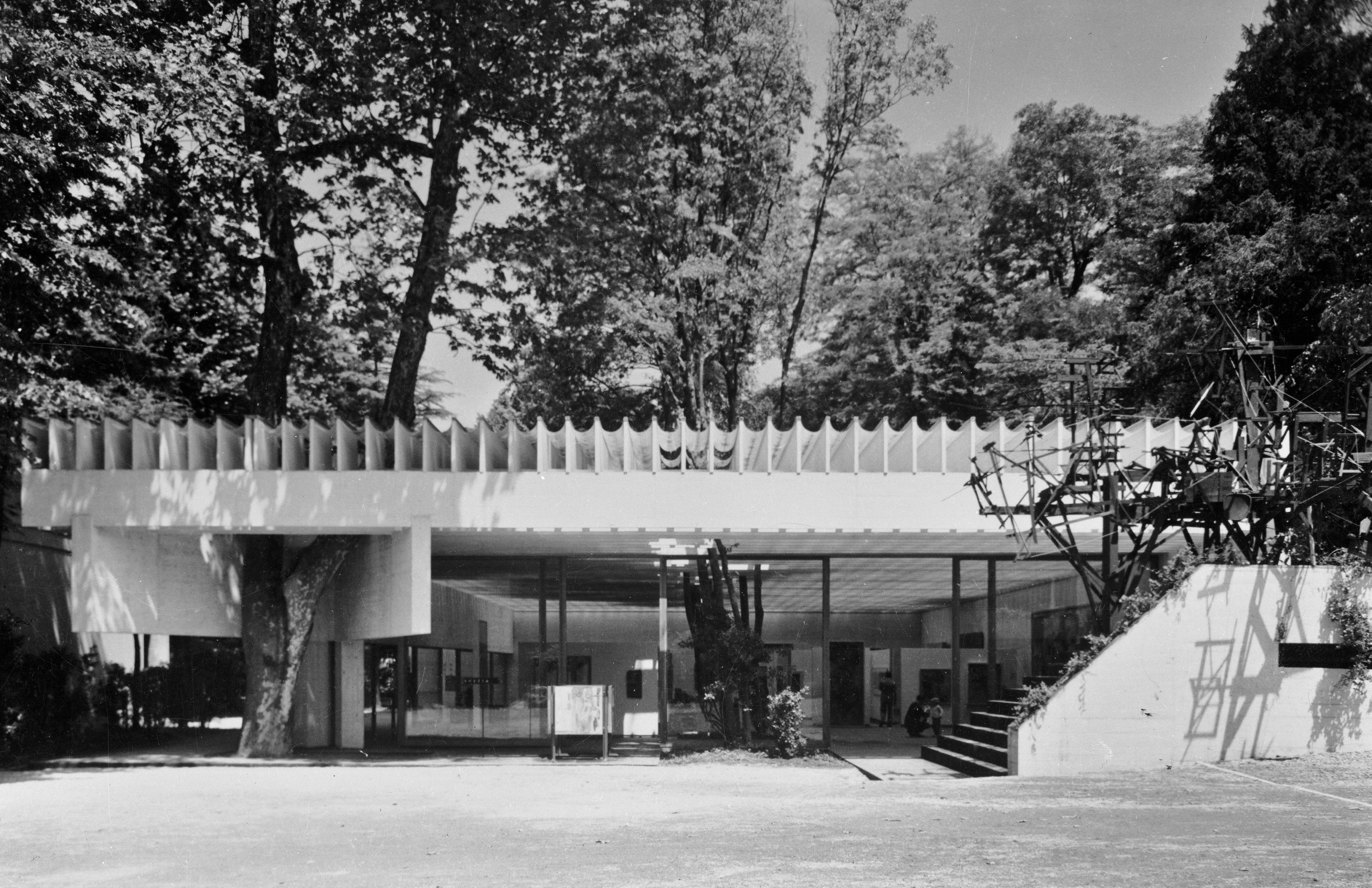
Architecture is – in Fehn’s eyes – nothing but a “process of reducing things to the basic opposition between earth and sky”. The human being exists at the meeting point where both opposites come together; the known and the unknown. According to Fehn, the goal of architecture is then to ‘rescue’ the earth and the sky from their indefinite natural identity and make them “perceptible and measurable”. The tree is an object that represents this meeting point between earth and sky. Fehn has formulated the working of the tree in the following manner: “The point of intersection, the horizon, is where the tree gathers all its strength and reaches its maximum constructive size. From that point, the plant branches out in both directions toward minimal expression, stretching its roots down into the darkness and its branches up toward the light.” As the ‘above’ provides the tree with oxygen and light, the ‘beneath’ provides nutrition and stability. The tree completely radiates in its form this very polarity. In the same way, our existence on earth is only realised by the coming together of those two dimensions. It is through architecture that Fehn aims to make one aware of this fundamental root of existence. The Nordic Pavilion is an attempt to let one dwell in that ‘in-between’ space. By lowering the sky to a surface that “belongs to the building” and by creating a confrontation between “the plane upon which things rest and the one that light penetrates”, he realises a potential meeting point.
Unpublished Work © 2020 Joseph Gardella
 Joseph G. Gardella: Portfolio